
If you follow the world of Electric Vehicles (EVs) and smart cities, you’ve likely heard the term V2X—Vehicle-to-Everything. It’s the “holy grail” of tech that allows cars to talk to traffic lights (V2I), other cars (V2V), and even power your home (V2H) or the electric grid (V2G).
But if you live in Florida, you might be wondering: Where are our V2X programs?
While it might seem like the Sunshine State is lagging behind, the truth is more nuanced. Florida isn’t ignoring V2X; it’s just approaching it differently than you might expect.
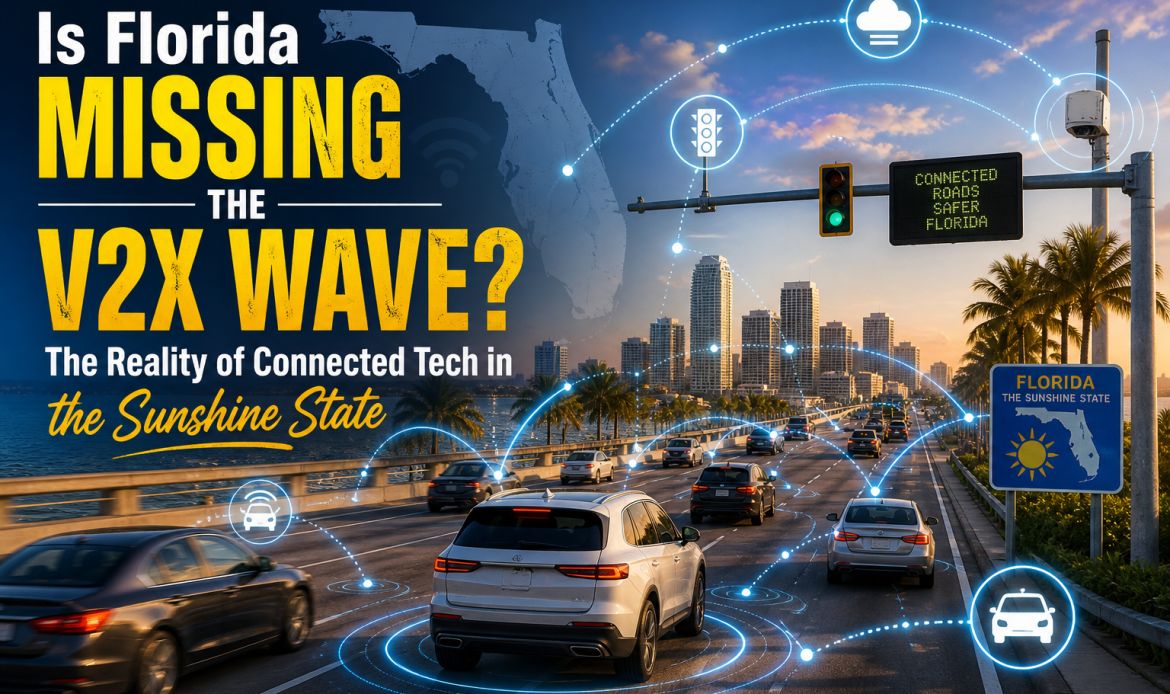
1. The “Invisible” V2X: Smart Infrastructure
Most people think of V2X as a car feature, but for it to work, the roads have to talk back. The Florida Department of Transportation (FDOT) has actually been a leader in the “hidden” side of V2X. Through various pilot programs and partnerships with tech giants, Florida has been building a Connected Vehicle Data Exchange Platform.
The goal? To create a statewide ecosystem where vehicles can receive real-time safety alerts about road hazards or pedestrian crossings. You might not see it on your dashboard yet, but the digital foundation is being laid.
2. The Missing Piece: Vehicle-to-Grid (V2G)
If you’re looking for programs that let your EV power your house during a hurricane (V2H) or sell power back to the grid (V2G), you’ll find fewer options here than in states like California. There are a few reasons for this:
- Utility Control: Florida’s energy landscape is dominated by large, regulated utilities. Transitioning to a “decentralized” grid where thousands of cars act as mini-batteries requires massive regulatory shifts that are still in the early stages.
- Infrastructure Rollout: While Florida has received significant federal funding for EV charging, the priority has been on basic charging stations rather than advanced V2X-capable bidirectional chargers.
- Hardware Adoption: Only a handful of EVs currently sold in the U.S. (like the Ford F-150 Lightning or the Nissan Leaf) support bidirectional power. Until more cars have the tech, utilities have less incentive to build the programs.
The Bottom Line
Florida isn’t sitting on the sidelines; it’s focused on safety and data first. While we may not have widespread “power-your-home-with-your-car” rebates just yet, the state’s investment in connected infrastructure means that when the technology hits the mainstream, Florida’s roads will be ready to “talk.”
Hurricane Resilience: V2X as a Lifeboat
In Florida, “resilience” isn’t just a buzzword—it’s a survival strategy. While we haven’t reached full-scale Vehicle-to-Grid (V2G) adoption, the state is increasingly viewing EVs as mobile power plants for emergencies. [1]
- Mobile Emergency Charging: During the 2024 hurricane season, Florida deployed emergency mobile EV charging stations along major evacuation routes like I-75 and I-4 to prevent drivers from being stranded.
- Grid Hardening & Recovery: Local utilities like Florida Power & Light (FPL) and Duke Energy Florida are making massive investments in “grid hardening”. This infrastructure is the prerequisite for V2G; before your car can give power back to the grid, the grid must be strong enough to receive it without failing.
- The V2H Potential: For many Floridians, the most immediate “V2X” benefit will likely be Vehicle-to-Home (V2H). Imagine using your truck to keep your AC and fridge running for days after a storm passes—this “islanded” power is a major selling point that could drive adoption faster than utility-led programs. [1]
The NEVI Boost: Building the Backbone [1]
The federal National Electric Vehicle Infrastructure (NEVI) program is the silent engine behind Florida’s charging rollout. Florida is estimated to receive approximately $198 million over five years to build a reliable fast-charging network. [1, 2]
- Priority on Evacuation Routes: Florida’s NEVI plan specifically prioritizes Alternative Fuel Corridors (AFCs), ensuring that fast chargers are placed every 50 miles along interstates to support massive evacuations.
- Statewide Coordination: The Florida Department of Transportation (FDOT) is using these funds to ensure that charging isn’t just for city centers, but also for rural and underserved areas, creating a truly statewide “resilient” network.
- A “Call to Action”: Nationally, V2X is being treated as a critical safety technology. Federal grants (like the $60 million recently announced by the FHWA) are designed to ensure that no matter where you drive, your vehicle can communicate securely with the world around it. [1, 2, 3, 4, 5]